
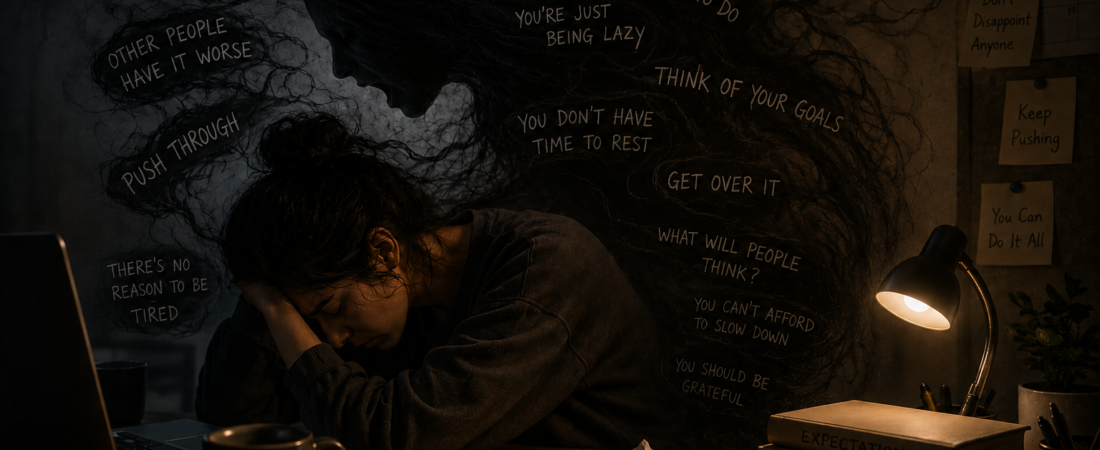
Have you ever noticed how quickly you dismiss your own exhaustion?
You wake up tired, push through the day, and tell yourself you’ll rest later. Later comes, and somehow there is always something else that needs your attention. Another task. Another responsibility. Another person who needs something from you.
And when your body finally starts asking for a break, a familiar voice appears.
“You’re being lazy.”
“Other people have it harder.”
“You haven’t done enough yet.”
“Keep going.”
For many of us, exhaustion isn’t the hardest part.
The hardest part is feeling guilty for being exhausted in the first place.
When Rest Starts Feeling Like Something You Have to Earn
We weren’t born believing we had to earn rest.
Somewhere along the way, we learned it.
Maybe it came from growing up in an environment where productivity was constantly praised. Maybe it came from watching parents who never stopped working. Maybe it came from being rewarded only when we achieved something and overlooked when we simply existed.
Whatever the source, many of us absorbed the same message: your worth is tied to what you accomplish.
The result is that rest begins to feel conditional.
We tell ourselves we’ll slow down after the project is finished. After the children are taken care of. After the deadlines are met. After the house is clean. After we’ve proven we’ve worked hard enough.
The problem is that the finish line keeps moving.
There is always another reason to postpone taking care of ourselves.
And over time, we stop seeing rest as a basic human need and start treating it like a reward reserved for people who have done enough to deserve it.
The People Who Carry the Most Often Feel the Least Entitled to Pause
There is a particular kind of person who struggles with this more than most.
The dependable one.
The responsible one.
The one everyone calls when something goes wrong.
The one who rarely asks for help because they are usually the person providing it.
When you’ve spent years being the strong one, exhaustion can feel like failure. You’ve built an identity around being capable, reliable, and resilient. Admitting that you’re tired can feel as though you’re admitting that you’re falling apart.
So instead, you keep going.
You continue showing up.
You continue carrying responsibilities long after your mind and body have started asking for relief.
From the outside, people admire your strength.
What they don’t see is how much of that strength is fueled by fear.
The fear of letting people down.
The fear of appearing weak.
The fear of discovering that your value has become tied to how much you can endure.
The Exhaustion Beneath the Exhaustion
Physical tiredness is relatively straightforward.
You sleep.
You recover.
You regain energy.
But emotional exhaustion is different.
Emotional exhaustion comes from constantly being needed.
From carrying responsibilities that never seem to end.
From managing expectations, solving problems, making decisions, and holding everything together.
What makes it even more difficult is that emotional exhaustion often comes with self-judgment.
You aren’t just tired.
You’re angry at yourself for being tired.
You aren’t just overwhelmed.
You’re frustrated that you’re overwhelmed.
You aren’t just struggling.
You’re criticizing yourself for struggling.
And that second layer of suffering can become heavier than the exhaustion itself.
Because now you’re carrying both the burden and the belief that you should be able to carry it better.
The Voice Isn’t Actually Yours
One of the most surprising realizations many of us have is that the harshest voice in our heads often didn’t start there.
That voice was learned.
It may sound like a parent who valued achievement above all else.
A teacher who praised perfection.
A culture that glorified busyness.
A workplace that treated burnout as dedication.
A family environment where everyone was expected to be strong regardless of what they were carrying.
Over time, those messages become internalized.
Eventually, nobody needs to pressure us anymore.
We do it ourselves.
We become both the exhausted person and the person demanding more from them.
The voice feels like our own because we’ve heard it for so long.
But that doesn’t mean it speaks the truth.
You Were Never Meant to Function Like a Machine
Perhaps the emotional truth most of us avoid is this:
Being tired does not mean you’re failing.
It means you’re human.
No amount of discipline, ambition, resilience, or strength changes the fact that human beings have limits. We need rest. We need recovery. We need moments where we are allowed to stop producing, solving, fixing, and carrying.
Yet many of us continue treating ourselves with a level of harshness we would never direct toward someone we love.
If a friend came to us exhausted, we would likely tell them to take care of themselves.
To slow down.
To rest.
To be gentle with themselves.
For some reason, we struggle to offer ourselves that same compassion.
Instead, we keep moving as though our exhaustion is something to overcome rather than something to listen to.
Maybe You’re Tired Because You’ve Been Carrying Too Much
What if the exhaustion you’re feeling isn’t evidence that you’re weak?
What if it’s evidence that you’ve been strong for too long without enough support?
What if your tiredness isn’t a character flaw that needs fixing, but a message that deserves attention?
We live in a world that often celebrates endurance while overlooking the cost of it. We praise people for pushing through, staying strong, and carrying on. But very few people stop to ask what that constant carrying is doing to them.
Perhaps that’s why so many of us feel exhausted long before we allow ourselves to admit it.
We’ve learned how to keep going.
We were never taught how to stop.
Giving Yourself Permission
Maybe the voice in your head will still show up tomorrow.
Maybe it will still tell you that you should be doing more.
That you haven’t earned a break.
That everyone else is handling life better than you are.
But perhaps healing begins when we stop treating that voice as an authority.
Perhaps it begins when we recognize that being tired is not a moral failure.
It is not weakness.
It is not laziness.
It is not proof that we’re falling behind.
It is simply what happens when a human being has been carrying more than they were meant to carry alone.
And maybe, just maybe, you don’t need permission to rest.
Maybe the fact that you’re tired is permission enough.
If this reflection resonated with you, stay connected. Together, we’ll continue exploring the quiet emotional experiences, hidden pressures, and unspoken struggles that so many of us carry every day.
Leave a Reply